


Summary
Google DeepMind on Monday released Gemini Robotics-ER 1.6 — an upgraded embodied reasoning model that gives robots significantly sharper spatial and visual intelligence — now available to developers via the Gemini API and Google AI Studio.

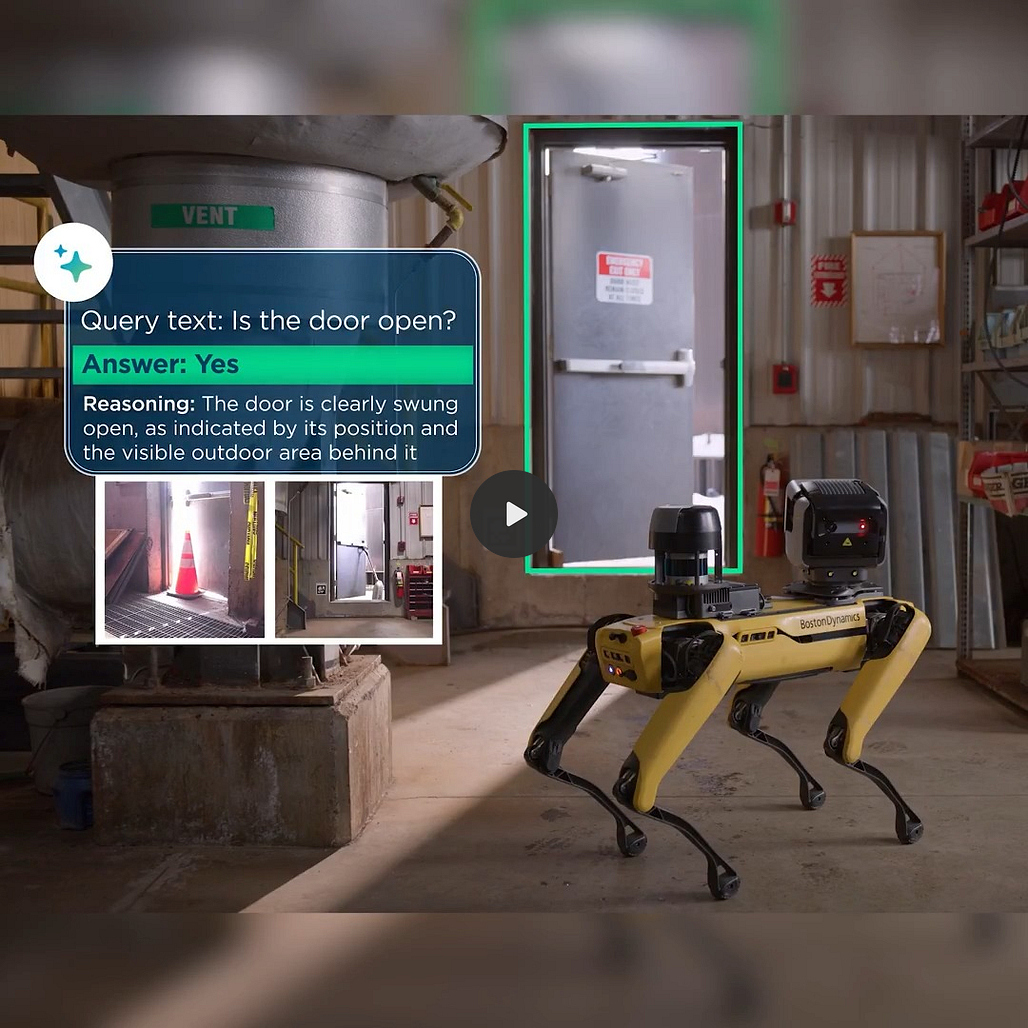
The release centers on a new capability developed directly with Boston Dynamics: instrument reading, which allows robots like Spot to autonomously interpret complex industrial gauges, pressure meters, and chemical sight glasses without human assistance. The model achieves this through agentic vision — a method combining visual reasoning with code execution — zooming into fine details, estimating proportions, and applying world knowledge to derive sub-tick-accurate readings. On instrument reading benchmarks, ER 1.6 with agentic vision scores 93%, compared to 23% for its predecessor ER 1.5.
Beyond gauge reading, the model advances four other capabilities that collectively push robots closer to real operational autonomy: precise object detection and counting in cluttered environments, multi-view success detection that fuses simultaneous camera streams to determine when a task is complete, physical safety constraint adherence (avoiding liquids, respecting weight limits), and injury-risk identification — outperforming the Gemini 3.0 Flash baseline by 6% on text-based hazard detection and 10% on video.
The instrument reading use case is emblematic of a broader pattern: rather than general-purpose improvements, Gemini Robotics-ER 1.6’s most distinctive gains were co-developed with an industrial partner around a specific deployment need, suggesting Google DeepMind is prioritizing real-world traction over benchmark performance alone.
Google DeepMind is inviting robotics developers to submit labeled failure-mode images to inform upcoming model iterations.